
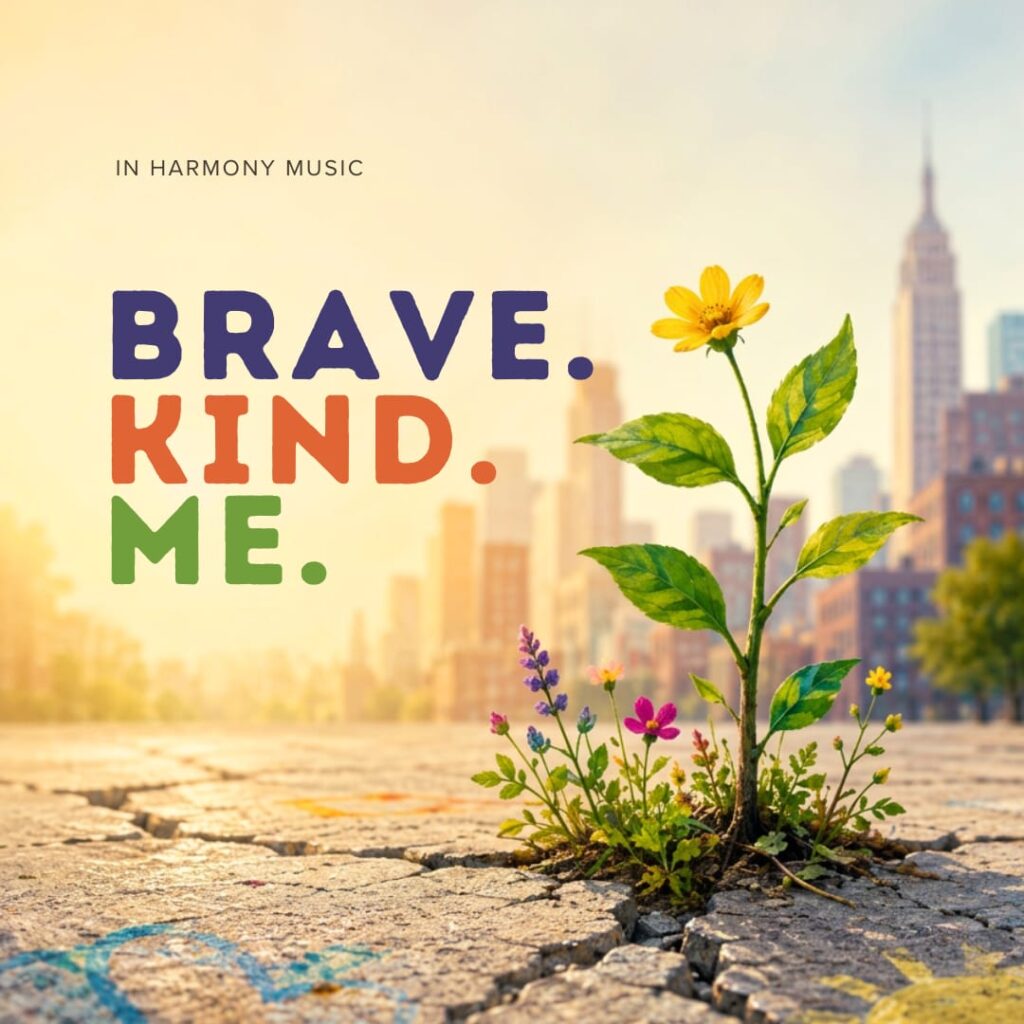
After more than two decades of working with children, families, and educators, In Harmony Music founder Justine Chadly is bringing a deeply personal philosophy of education to a new generation through Brave. Kind. Me.
For more than two decades, Justine Chadly has watched children discover themselves through music. As the founder of In Harmony Music, established in 2003, Chadly has spent years working directly with children, families, teachers, and communities, developing an approach to music education that reaches beyond musical technique. Her work is grounded in the belief that children learn not only by listening and observing, but through movement, creativity, play, connection, and the freedom to express themselves. That philosophy has become the foundation for an organization that views music not simply as a subject to be taught, but as an experience through which children can develop confidence and a sense of belonging.
That philosophy is at the heart of Brave. Kind. Me., the newest album from In Harmony Music, released August 30, 2026. While the record is designed for children, its subject matter speaks to some of the most consequential questions facing parents and educators today: how children learn to understand difference, how they develop empathy, how they form friendships, and how they begin to understand who they are within a larger community. Rather than approaching these subjects as lessons to be memorized, the album uses music as an environment in which children can experience them.
This distinction is central to Chadly’s educational philosophy. In a culture increasingly focused on measurable outcomes, structured learning, and academic achievement, there is a temptation to treat music and the arts as secondary experiences. Chadly’s work proposes something different. Music can be an educational tool, but it can also be a social and emotional language. It can give children opportunities to practice listening, cooperation, self expression, confidence, and empathy without requiring those experiences to be separated from the joy of being a child.
Where Education and Experience Meet
Brave. Kind. Me. was developed from an understanding that children encounter complicated social and emotional experiences long before they have the vocabulary to explain them. Friendship can involve conflict, exclusion, sharing, negotiation, and forgiveness. Difference can produce curiosity as well as uncertainty. Belonging can be something a child feels instinctively but struggles to describe. For educators and parents, the challenge is often finding ways to introduce these conversations without making them feel artificial or overly instructional.
The songs on the album provide another entry point. We All Belong explores the relationship between sameness and difference through an accessible musical experience, while My Friends addresses the everyday dynamics of childhood friendship, including sharing and taking turns. A Little Bit of Love approaches empathy through music rather than definition, giving children an opportunity to encounter the concept in a form that feels familiar and emotionally accessible. Other songs, including Elbow Macaroni and Baila, bring humor, movement, and play into the collection, reinforcing the idea that a healthy childhood cannot be reduced to instruction.
That balance is intentional. In Harmony Music does not treat music as another classroom assignment that children must complete. Instead, the organization creates experiences in which learning can happen naturally. A teacher may use a song to begin a discussion about inclusion, a parent may hear a child singing a lyric and use it as an opening for conversation, or children may simply enjoy the music without consciously recognizing its educational dimension. The experience remains valuable in all three circumstances.
Chadly and Creative Director Tom Foote describe the philosophy simply through the idea that they are not trying to make music children merely consume, but music they can live inside. That idea captures the distinction between a song that communicates a lesson and a song that becomes part of a child’s experience. When music becomes familiar enough to sing spontaneously, it can move beyond the moment in which it was introduced and become part of a child’s everyday language.
Creating Music From the Reality of Childhood
The distinction between music written about children and music developed through engagement with children is important to In Harmony’s work. Rather than creating songs exclusively in a studio environment and then introducing them into educational settings, the organization’s approach has been informed by direct observation and interaction in schools and classrooms. Chadly and her team have spent time listening to teachers, observing children, and considering how young people actually respond to conflict, difference, friendship, connection, and play.
That experience gives the album a practical quality. Its themes do not exist in isolation from the ordinary circumstances of childhood. They emerge from situations that teachers and parents encounter every day. A song about friendship can become relevant during a disagreement on the playground. A song about belonging can resonate when a new child enters a classroom. A song about empathy can create an opportunity for a child to think about how someone else might feel.
The result is a collection that can move comfortably between educational and family environments. The album does not require a teacher to transform a song into a formal lesson, nor does it require a parent to prepare an activity around it. The music can simply become part of the environment in which children live and learn.
That quality has already been reflected in the response from educators who encountered the material during an In Harmony teaching workshop. Songs such as Elbow Macaroni, Baila, and We All Belong were picked up quickly, with educators responding particularly warmly to We All Belong and identifying Elbow Macaroni as a likely classroom favorite. The response illustrates the practical strength of music that can be immediately engaging while still carrying a deeper purpose.
Taking Children’s Music Seriously
Tom Foote, the album’s Creative Director and a drummer, producer, and composer associated with Rhythm Kids, brings decades of experience creating and performing music for children and educators. His contribution helps give Brave. Kind. Me. a musical range that extends beyond the conventions sometimes associated with children’s recordings. The album moves through different styles while maintaining accessibility for young listeners, allowing the music to remain playful without becoming musically simplistic.
That distinction matters because children’s music is often evaluated primarily by its usefulness to adults. A song may be considered successful because it teaches a concept, reinforces a routine, or keeps children engaged. In Harmony approaches the medium from another direction: children deserve music that respects their intelligence, curiosity, emotional lives, and capacity for aesthetic experience.
Boston based musician, saxophonist, and recording artist Pat Loomis, who performed on several tracks, has described the project as raising the bar in children’s music and music education. His assessment focuses on the strength of the songs themselves, as well as the quality of their vocals, production, and arrangements. That perspective reinforces one of the album’s broader ambitions: children’s music does not have to choose between artistic quality and educational purpose.
The Unexpected Full Circle
Perhaps the most meaningful story surrounding Brave. Kind. Me. is found in the people who helped create it. Several of the artists featured on the album were once Chadly’s students. Years after encountering music through her educational work, they have returned as professional musicians and collaborators.
For an educator, that kind of return carries a significance that cannot easily be captured in a résumé or professional accomplishment. It demonstrates what happens when teaching is viewed as an investment in a child’s developing creative identity rather than simply a process of producing a successful performance.
Chadly’s objective has always been to help children find their own voices. Having former students return as artists participating in her work creates a remarkable continuation of that philosophy. The classroom, in a sense, has become cyclical. The students who once received encouragement and instruction are now contributing their own experience and creativity to the next generation.
That makes Brave. Kind. Me. more than a new album. It is also a reflection on what education can leave behind. A teacher’s influence may not always be immediately measurable, but it can remain visible years later in the creative lives of the people who passed through the classroom.
Building a Broader Culture of Connection
The philosophy behind the album extends through the work of the In Harmony Foundation, the nonprofit arm of the organization. Through relationships with schools, libraries, therapists, and community organizations, the foundation seeks to support children experiencing isolation, trauma, and disconnection.
That work reflects a broader understanding of childhood development. A child’s sense of security and belonging is not shaped by one classroom or one teacher. It develops across a network of relationships and environments, including home, school, community, and the informal spaces where children play and interact. Music can move through all of those environments with unusual ease.
For parents and educators, that portability may be one of the album’s greatest strengths. The songs can become part of a morning routine, a classroom gathering, a family drive, or an afternoon of play. Their purpose does not depend on a formal setting.
Ultimately, Brave. Kind. Me. represents the continuation of an idea Chadly has pursued since founding In Harmony Music more than twenty years ago: that children deserve opportunities not only to learn, but to connect, create, move, question, and discover themselves.
The album’s title captures that philosophy in three simple words. Being brave, being kind, and becoming oneself are not isolated lessons. They are ongoing processes of childhood, shaped through relationships and experience. Through music, In Harmony is creating a space where those processes can be explored with joy.
Education does not end when the classroom does. Sometimes, it continues in a song a child carries with them.
Learn more about In Harmony Music: InHarmonyMusic.com
Follow In Harmony Music: Instagram | Facebook | YouTube @inharmonmusicca
Follow In Harmony Foundation: Instagram | YouTube @inharmonyfoundation


